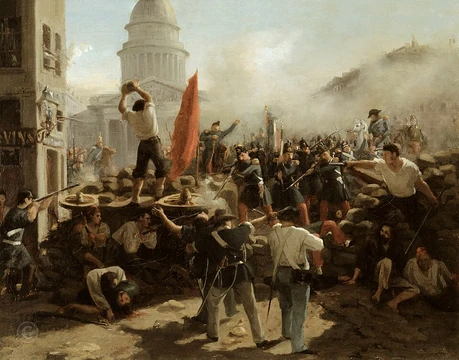
Taiping Rebellion
A 14-year civil war that was the deadliest of the 19th century.

The Taiping Rebellion was a civil war in late imperial China between the Qing dynasty and the rebel Taiping Heavenly Kingdom. The conflict lasted 14 years, from its outbreak in 1850 until the fall of Taiping-controlled Nanjing—which had been renamed to Tianjing ("heavenly capital")—in 1864. The last rebel forces were defeated in August 1871. Estimates of the conflict's death toll range between 20 to 30 million people, representing 5–10% of China's population at that time, while higher estimates range from 73 to 100 million, roughly up to one quarter of the Chinese population at that time, making it perhaps the deadliest civil war in all of human history. While the Qing ultimately defeated the rebellion, the victory came at a great cost to the state's economic and political viability.
- Conflict type
- Civil war
- Duration
- 1850–1864 (last forces defeated August 1871)
- Death toll estimate
- 20–30 million (5–10% of population) or 73–100 million (up to one quarter)
- Location
- Mid- and lower Yangtze valley, central and southern China
- Belligerents
- Qing dynasty vs. Taiping Heavenly Kingdom
- Leader of Taiping
- Hong Xiuquan
- Outcome
- Qing victory, but at great cost to economic and political viability
Verified Timeline
Lore & Background
The uprising was led by Hong Xiuquan, an ethnic Hakka who, after a series of visions, proclaimed himself to be the younger brother of Jesus Christ. Hong sought the religious conversion of the Han people to his syncretic version of Christianity, as well as the political overthrow of the Qing dynasty, and a general transformation of the mechanisms of state. Rather than supplanting China's ruling class, the Taiping rebels sought to entirely upend the country's social order. The Taiping Heavenly Kingdom in Nanjing seized control of significant portions of southern China. At its peak, the Heavenly Kingdom ruled over a population of nearly 30 million. For more than a decade, Taiping armies occupied and fought across much of the mid- and lower Yangtze valley, ultimately devolving into civil war. It was the largest war in China since the Ming–Qing transition, involving most of Central and Southern China. Taiping soldiers carried out widespread massacres of Manchus, the ethnic minority of the ruling Imperial House of Aisin-Gioro. Meanwhile, the Qing government also engaged in massacres, most notably against the civilian population of Nanjing. Weakened severely by internal conflicts following the failure of the campaign against Beijing (1853–1855) and an attempted coup in September and October 1856, the Taiping rebels were defeated by decentralised provincial armies such as the Xiang Army organised and commanded by Zeng Guofan. After moving down the Yangtze River and recapturing the strategic city of Anqing, Zeng's forces besieged Nanjing during May 1862. After two more years, on June 1, 1864, Hong Xiuquan died during the siege, caused from the consumption of weeds in the palace grounds as well as suspicions of poison. Nanjing fell barely a month later.
Reader's Guide
The 14-year civil war, along with the internal and external conflicts of the Opium Wars and the Boxer Rebellion, weakened the Qing dynasty's grasp on central China. The Taiping rebellion prompted the government's initially successful "Self-Strengthening Movement", but continued social and religious unrest exacerbated ethnic disputes and accelerated the rise of provincial powers. The Warlord Era, the loss of central control after the establishment of the Republic of China, would begin in earnest in 1912. The war was characterized by extreme brutality on both sides. Thirty million people fled the conquered regions to foreign settlements or other parts of China. Historians debate the naming of the conflict: some call it the "Taiping Rebellion," others the "Taiping Civil War" or "Taiping Revolution," reflecting different views on the legitimacy of the Qing government and the transformative nature of the Taiping movement. The Qing referred to it as a period of chaos (亂; luàn), rebellion (逆; nì) or military ascendancy (軍興; jūnxìng), often calling it the Hong-Yang Rebellion (洪楊之亂; Hóngyáng zhī luàn) after the two most prominent leaders. In modern China, it is often called the Taiping Heavenly Kingdom Movement (太平天國運動; Tàipíng tiānguó yùndòng), due to the fact that the Taiping espoused a doctrine which was both nationalist and communist.
Did You Know?
- Hong Xiuquan proclaimed himself to be the younger brother of Jesus Christ after a series of visions.
- The Taiping renamed Nanjing to Tianjing, meaning 'heavenly capital'.
- At its peak, the Taiping Heavenly Kingdom ruled over a population of nearly 30 million.
- Hong Xiuquan died on June 1, 1864, during the siege of Nanjing, from consuming weeds in the palace grounds as well as suspicions of poison.
- The Qing referred to the Taiping as 'Yue Bandits' (粵匪; Yuèfěi) in official sources, a reference to their origins in Guangdong.
Frequently Asked Questions
What is the Taiping Rebellion?
It was a 14-year civil war in late imperial China that pitted the Qing dynasty government against the rebel Taiping Heavenly Kingdom. The fighting centered on the mid- and lower Yangtze valley region of central and southern China, beginning in 1850.
Who led the Taiping Rebellion?
Hong Xiuquan founded the Taiping Heavenly Kingdom and served as its supreme leader, casting himself in a divine role. He established his seat of power in Nanjing, which he renamed Tianjing, or 'heavenly capital,' to reflect the theocratic nature of his state.
How did the Taiping Rebellion end?
Qing loyalist forces stormed and recaptured Tianjing (Nanjing) in 1864, collapsing the rebel government's core. The last scattered Taiping holdouts were not fully defeated until August 1871, closing out the conflict.
How many people died in the Taiping Rebellion?
Most estimates place the toll between 20 and 30 million, roughly 5–10% of China's population at the time, though some scholars argue for figures as high as 73–100 million. Either way, it stands as the deadliest single conflict of the nineteenth century.
Why is the Taiping Rebellion considered so significant?
Its staggering death toll and the sheer scale of the fighting exposed the Qing dynasty's deep military and administrative weaknesses to both domestic and foreign observers. The upheaval also accelerated internal reform debates and opened the door to greater foreign influence in Chinese affairs in the decades that followed.
More in Revolutions & Uprisings 1-15
Spotted an error? Know more?
This is a living reference — every entry is fact-audited, and reader corrections feed straight into our audit queue. Suggest an edit · See this site's audit record