French Revolution
Period of civil unrest in France that led to the collapse of the July Monarchy.

Thom Quine · CC BY 2.0
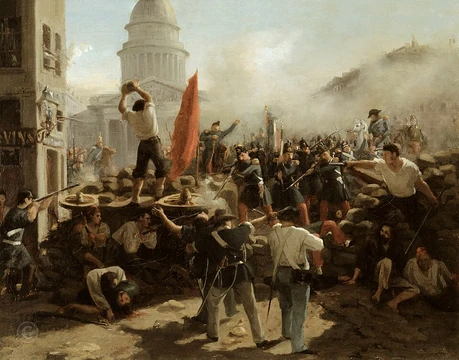
The French Revolution of 1848, also known as the February Revolution, was a period of civil unrest in France, in February 1848, that led to the collapse of the July Monarchy and the foundation of the French Second Republic. It sparked the wave of revolutions of 1848. The revolution took place in Paris, and was preceded by the French government's crackdown on the campagne des banquets.
- started
- 22 February 1848
- ended
- 24 February 1848
- field
- Civil unrest and political change
- nationality
- French
- known_for
- Collapse of the July Monarchy, foundation of the French Second Republic
Verified Timeline
Lore & Background
Starting on 22 February as a large-scale protest against the government of François Guizot, it later developed into a violent uprising against the monarchy. After intense urban fighting, large crowds managed to take control of the capital, leading to the abdication of King Louis Philippe I on 24 February and the subsequent proclamation of the Second Republic. The revolution was preceded by the French government's crackdown on the campagne des banquets.
Reader's Guide
Under the Charter of 1814, Louis XVIII ruled France as the head of a constitutional monarchy. Upon his death, his brother Charles X ascended to the throne in 1824. Supported by the ultra-royalists, Charles X was an extremely unpopular reactionary monarch. In 1830, Charles X issued the Four Ordinances of St. Cloud, which abolished freedom of the press, reduced the electorate by 75%, and dissolved the lower house. This provoked the Three Glorious Days of 26–29 July 1830, forcing Charles to abdicate and flee to the United Kingdom. Louis Philippe, of the Orléanist branch, rose to power, replacing the old Charter by the Charter of 1830, and his rule became known as the July Monarchy.
Did You Know?
- The revolution is also known as the February Revolution.
- It sparked the wave of revolutions of 1848 across Europe.
- King Louis Philippe I abdicated on 24 February 1848.
- Only about one percent of the population held the franchise by 1848.
- The revolution was preceded by the government's crackdown on the campagne des banquets.
The Narrow Franchise and the Banquets Campaign
By 1848, only about one percent of the population held the franchise. Although France had a free press and trial by jury, only landholders were permitted to vote, which alienated the petite bourgeoisie and even the industrial bourgeoisie from the government. A reform movement developed which urged the government to expand the electoral franchise, just as Great Britain had done with the Reform Act 1832. The more radical democrats coalesced around the newspaper La Réforme; the more moderate republicans and the liberal opposition rallied around Le National. Starting in July 1847 the reformists of all shades began to hold banquets at which toasts were drunk to 'République française' and 'Liberté, égalité, fraternité'. Louis Philippe turned a deaf ear to the reform movement. Alexis de Tocqueville observed, 'We are sleeping together in a volcano. ... A wind of revolution blows, the storm is on the horizon.'
The February Uprising and the Fall of the Monarchy
The revolution took place in Paris, and was preceded by the French government's crackdown on the campagne des banquets. Starting on 22 February as a large-scale protest against the government of François Guizot, it later developed into a violent uprising against the monarchy. After intense urban fighting, large crowds managed to take control of the capital, leading to the abdication of King Louis Philippe I on 24 February and the subsequent proclamation of the Second Republic. It sparked the wave of revolutions of 1848.
Economic Collapse and Social Suffering
The year 1846 saw a financial crisis and bad harvests, and the following year saw an economic depression. A poor railway system hindered aid efforts, and the peasant rebellions that resulted were forcibly crushed. According to French economist Frédéric Bastiat, the poor condition of the railway system can largely be attributed to French efforts to promote other systems of transport, such as carriages. Perhaps a third of Paris was on social welfare. Writers such as Louis Blanc and Pierre-Joseph Proudhon proliferated. The only nominally social law of the July Monarchy was passed in 1841, prohibiting the use of labor of children under eight years of age and the employment of children less than 13 years old for night-time work. This law was routinely flouted.
A Monarchy Divided by Class
Nicknamed the 'Bourgeois Monarch', Louis Philippe sat at the head of a moderately liberal state controlled mainly by an educated elite. He was supported by the Orléanists and opposed on his right by the Legitimists and on his left by the Republicans. Louis Philippe saw himself as the successful embodiment of a 'small businessman'. He did support the bankers, large and small. At the beginning of his reign in 1830, Jacques Laffitte said 'From now on, the bankers will rule.' During his reign, the privileged 'financial aristocracy' tended to support him, while the industrial section of the bourgeoisie were disfavored and tended to side with the middle class and laboring class in opposition to Louis Philippe in the Chamber of Deputies. Land-ownership was favored, and this elitism resulted in the disenfranchisement of much of the middle and working classes. Early in 1848, some Orléanist liberals, such as Adolphe Thiers, had turned against Louis Philippe, disappointed by his opposition to parliamentarism.
Gallery



Frequently Asked Questions
What is the French Revolution of 1848?
It was a brief but decisive burst of civil unrest in Paris during February 1848 that toppled the July Monarchy and gave birth to the French Second Republic. It is also commonly called the February Revolution.
When did the French Revolution of 1848 take place?
The uprising ran from 22 February to 24 February 1848, making it a remarkably compressed three-day event. All of the key political upheaval unfolded within that narrow window in Paris.
What triggered the French Revolution of 1848?
The immediate spark was the French government's crackdown on the campagne des banquets, a series of political banquets that had become a vehicle for republican opposition. That suppression pushed Parisians into open revolt.
What were the main outcomes of the French Revolution of 1848?
The July Monarchy collapsed and was replaced by the French Second Republic. It is primarily remembered for that regime change and for setting the stage for a broader wave of uprisings across Europe in 1848.
Why is the French Revolution of 1848 considered important?
Beyond reshaping France's own government, it ignited the wider wave of revolutions of 1848 that swept through multiple European nations. Its three-day arc in Paris became a model of how popular unrest can rapidly dismantle an established monarchy.
More in Revolutions & Uprisings 1-15
Spotted an error? Know more?
This is a living reference — every entry is fact-audited, and reader corrections feed straight into our audit queue. Suggest an edit · See this site's audit record