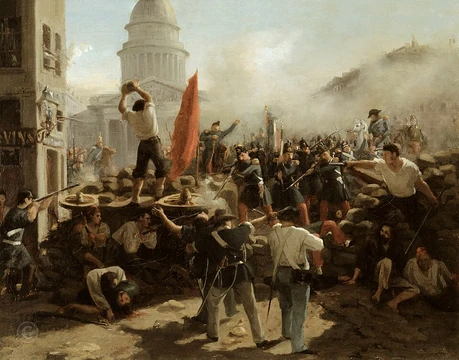
Russian Revolution
Forced the establishment of a constitutional monarchy and the first formal constitution in Russia.

The Russian Revolution of 1905, also known as the First Russian Revolution, was a revolution in the Russian Empire which began on 22 January 1905 and led to the establishment of a constitutional monarchy under the Russian Constitution of 1906, the country's first formal constitution. The revolution was characterized by mass political and social unrest including worker strikes, peasant revolts, and military mutinies directed against Tsar Nicholas II and the autocracy, who were forced to establish the State Duma legislative assembly and grant certain rights, though both were later undermined.
- start_year
- 1905
- end_year
- 1907
- location
- Russian Empire
- type
- Political and social revolution
- key_outcome
- Establishment of a constitutional monarchy under the Russian Constitution of 190
- major_factions
- Socialist Revolutionary Party, Russian Social Democratic Labour Party, Black Hun
Verified Timeline
Lore & Background
The revolution began on 22 January [O.S. 9 January] 1905, known as 'Bloody Sunday,' when a peaceful procession of workers, led by Georgy Gapon, was fired on by guards outside the tsar's Winter Palace in Saint Petersburg. Widespread demonstrations and traditional strikes spread all over the empire and were brutally repressed by the tsar's troops. In June, sailors on the battleship Potemkin undertook a mutiny, and in October, a strike by railway workers turned into a general strike in Saint Petersburg and Moscow. The striking urban workers established councils, including the inaugural St. Petersburg Soviet of Workers' Deputies, in order to debate their course of action. The influence of revolutionary parties, in particular the Socialist Revolutionary Party and Russian Social Democratic Labour Party, quickly escalated. At the same time, the reactionary pro-monarchist Black Hundreds began attacks on intellectuals, revolutionaries, and the Jewish population. In response, the tsar issued the 'October Manifesto,' a pledge to create a legislative assembly, halt censorship and violations of freedom of association, and expand the right to vote. The constitution, drafted by Sergei Witte and enacted on 6 May [O.S. 23 April] 1906, did not bring an end to the turmoil, as anti-monarchist revolutionaries continued to rally for a constituent assembly.
Reader's Guide
The movement for reform fragmented into conservative Octobrist and liberal Kadet factions, and the left split into moderates content with the reforms and those who desired a full overthrow of the tsar. The revolution slowly fizzled out in the face of harsh repression as troops returned after the end of the Russo-Japanese War in September 1905. Despite popular participation, the Duma was unable to issue laws of its own and often came into conflict with the tsar, who in July 1906 dissolved the first Duma and appointed Pyotr Stolypin as prime minister, who set about restoring autocratic rule. In June 1907, the second Duma was dissolved and an electoral reform which favored the propertied classes was decreed. Many historians contend that the Revolution of 1905 set the stage for the Russian Revolution of 1917, which saw the monarchy abolished, the tsar executed, and a socialist state established. Vladimir Lenin later famously described the Revolution of 1905 as the 'dress rehearsal' without which the 'victory of the October Revolution in 1917 would have been impossible.'
Did You Know?
- The revolution began on 22 January 1905, known as 'Bloody Sunday,' when guards fired on a peaceful procession of workers led by Georgy Gapon outside the tsar's Winter Palace.
- In June 1905, sailors on the battleship Potemkin undertook a mutiny.
- The October Manifesto, issued by the tsar, pledged to create a legislative assembly, halt censorship, and expand the right to vote.
- The Russian Constitution of 1906, drafted by Sergei Witte, was enacted on 6 May [O.S. 23 April] 1906 as the country's first formal constitution.
- Vladimir Lenin described the Revolution of 1905 as the 'dress rehearsal' without which the 'victory of the October Revolution in 1917 would have been impossible.'
Frequently Asked Questions
What is the Russian Revolution of 1905?
It was a wave of mass unrest in the Russian Empire that kicked off in January 1905, driven by worker strikes, peasant uprisings, and military mutinies against Tsar Nicholas II's autocratic rule. The movement ultimately compelled the tsar to accept a constitutional monarchy and Russia's first formal constitution in 1906.
What were the main outcomes of the 1905 Russian Revolution?
The revolution forced the creation of the State Duma, a legislative body, and the adoption of the Russian Constitution of 1906, which established a constitutional monarchy. However, many of these gains were gradually eroded by the tsarist government in the years that followed.
How does the Russian Revolution of 1905 end?
The conflict wound down around 1907 after the tsarist regime cracked down on remaining opposition and diluted the powers of the newly created Duma. While the constitutional framework remained on paper, the autocracy largely reasserted its grip over political life.
Why is the 1905 Russian Revolution important?
It marked the first serious challenge to absolute tsarist rule and set a precedent for organized political opposition in Russia. The institutional changes it produced, even if later undermined, laid groundwork that would shape the more radical upheavals of 1917.
Which factions were central to the 1905 Russian Revolution?
The Socialist Revolutionary Party, the Russian Social Democratic Labour Party, and the Black Hundreds were among the most prominent groups on opposing sides. These factions represented the full spectrum from revolutionary socialism and organized labor politics to loyalist counter-revolutionary forces.
More in Revolutions & Uprisings 1-15
Spotted an error? Know more?
This is a living reference — every entry is fact-audited, and reader corrections feed straight into our audit queue. Suggest an edit · See this site's audit record